

The savoury smell of a home-cooked meal fills the air. Tsehaynesh sits down next to a simmering pot, stirs its bubbling contents and adds a pinch of salt. Elbetel, her daughter, seems to pop out of nowhere and gently tugs on her mother’s dress.
“Is it almost time?” Elbetel asks eagerly.
Tsehaynesh gives her daughter a nod, flashing her contagious smile. Elbetel lights up and scampers away, her laughter echoing through their small home as her father, Anteneh, dodges her dash across the room. Anteneh lets out a sigh of relief and chuckles, before setting down a fragrant loaf of freshly baked bread on the table.
As this young family gets ready to eat, their smiles are a little wider than usual. Hearts are a bit fuller. This is much more than a regular mealtime — it’s an Easter celebration, a meal that is marked by a deep sense of love, joy and hope.
Living with resilience
Anteneh and Tsehaynesh live in a small home in the Ginfile settlement of Addis Ababa, the capital city of Ethiopia. The community is made up of many retired war veterans who have settled in the area with their families. Community members struggle daily with the realities of poverty, and incomes are low for those who can find work in the area.
It wasn’t too long ago that Anteneh and his family found themselves struggling with these very challenges. Anteneh’s daily quest for work was a constant source of anxiety, with the uncertainty of earning a daily income casting a shadow over the family.
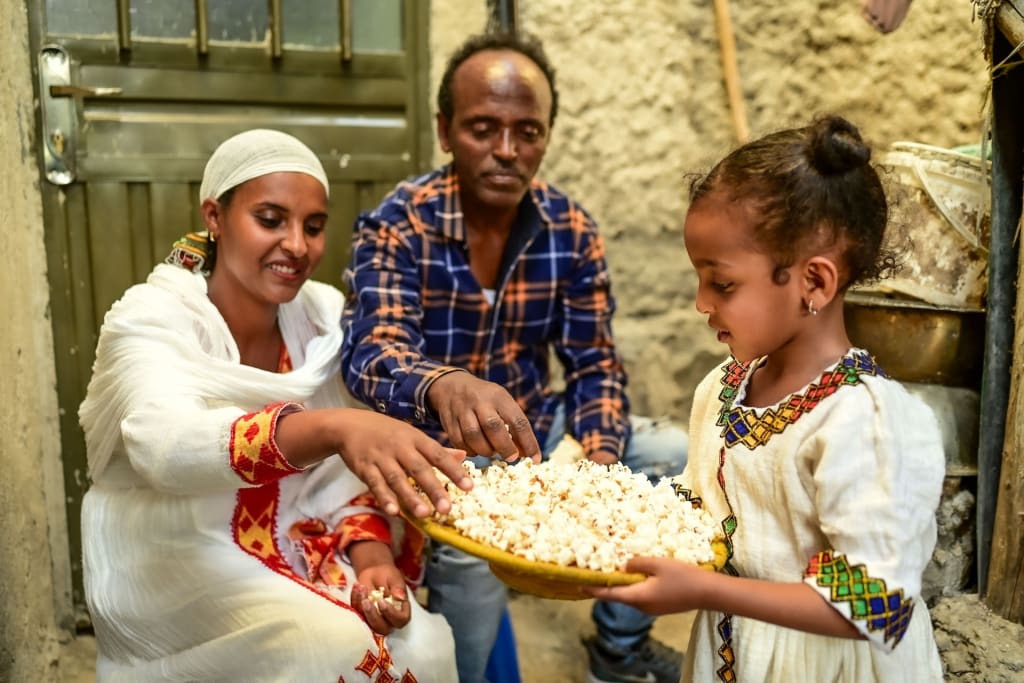
Popcorn! Elbetel gets to serve her family too, sharing a plate of popcorn with her parents.
But their family’s story is one of resilience. Hardship has only increased their resolve to make their home a place of love and care, not just for themselves, but also for their community.
For Anteneh, Tsehaynesh and their daughter Elbetel, holiday traditions like the ones they have for Easter help them celebrate the strength and love that have brought them through the highs and lows of life.
The protection and provision of a father
The Easter season in Ethiopia carries with it an extra sense of responsibility for fathers. As provider for the family, fathers like Anteneh ensure that their families have everything necessary to celebrate the holiday.
“When Easter comes, the main responsibility of the man in the house, the husband and the father, is to bring a hen, or a sheep, or even oxen meat [to share with] a group of people,” says Anteneh. He explains that this traditional feast of sharing meat among a community is called kircha.
As a part of the tradition, Anteneh also blesses the animal and prays for his family’s health, prosperity and unity. Kircha isn’t simply about providing food; rather, it speaks to a commitment to provide and protect, signifying Anteneh’s God-given role as the head of his household.
A mother’s unwavering love and care
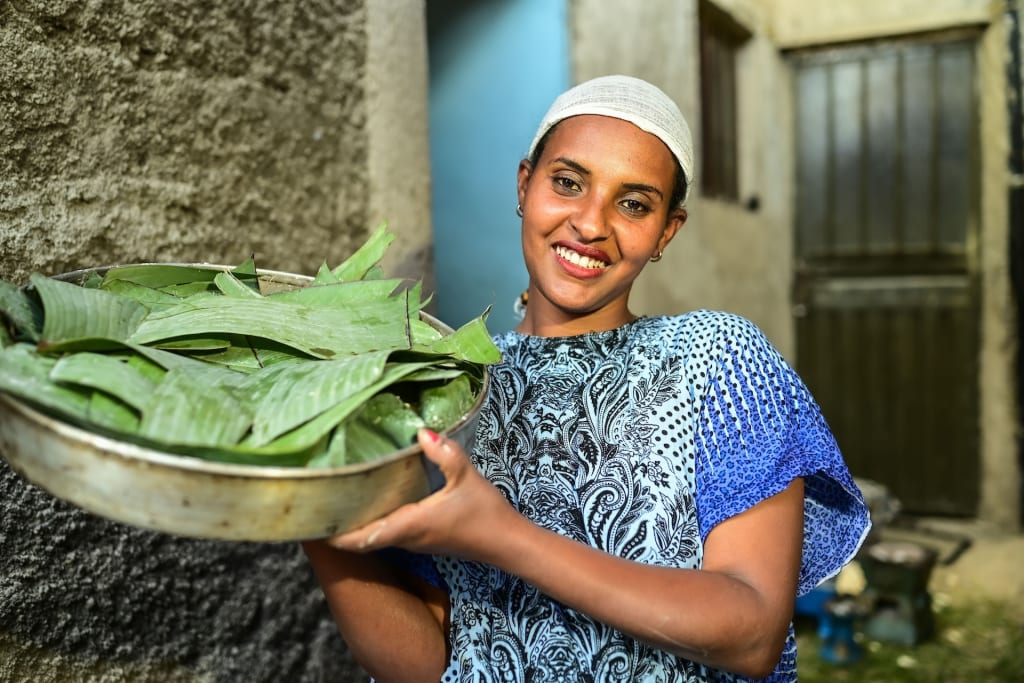
Tsehaynesh holds a pan of defo dabo, a bread that is baked carefully with banana leaves.
For Tsehaynesh, the work she puts into preparing the Easter feast is worth the love and affection that fills her home. Prep begins when her husband brings home chicken, which Tsehaynesh will use to cook a traditional stew known as doro wot.
“To prepare a doro wot, you must start by peeling onions, which takes hours. The sauce we make is another time-consuming process. Once you chop the onions, you roast them with oil, berbere (a red spice blend) and finally add butter. Now the sauce is ready to put the well-cleaned chicken in [to] boil,” explains Tsehaynesh.
While she focuses on cooking the chicken, Tsehaynesh also prepares two kinds of bread. Injera is a flatbread made with teff grain, an Ethiopian staple, and is served with the doro wot. Defo dabo, a holiday treat prepared uniquely with banana leaves, is a rich and fragrant bread made with honey and an array of spices.
Despite all the preparation, Tsehaynesh’s smile never fades: “The role of the mother is very tiresome and requires patience [on] holidays. But we do it out of love.” For her, the Easter holiday is a wonderful reminder of the joy of serving her family.
It’s time to eat
As Anteneh, Tsehaynesh and Elbetel sit down to eat, the meal begins with another tradition. Anteneh takes the loaf of defo dabo, blesses and breaks it — a symbol of his commitment to provide and spiritually nourish his family.
The traditions don’t stop there — even the way the meal is enjoyed is packed with meaning. The family eats from just a single plate, loaded with all the flavourful dishes Tsehaynesh has prepared. It signifies unity and speaks of how they share in each other’s sorrows and joys.

Anteneh does gursha for Tsehaynesh, feeding her from his hand.
Similarly, the tradition of feeding one another by hand, or gursha, symbolizes love, care and togetherness. “We do gursha not just for family members but also for friends and even strangers,” says Anteneh. “It’s a sign of courtesy, love and care.”
A little girl’s hopes and dreams

For four-year-old Elbetel, Easter is a time of joy and laughter. She watches both her parents with deep gratitude, and giggles as her father extends gursha to her. As she enjoys her food, Elbetel breaks out with a smile as she thinks about how her Compassion centre provided some of the ingredients they used for the meal.
She’s excited to return to the Compassion centre after the Easter celebrations, where she’ll learn new things about the world, hear stories about Jesus and dream big dreams for her future.
For Anteneh, Tsehaynesh and Elbetel, Easter is not just a holiday — it’s a celebration of life, a reaffirmation of their love and a reminder that even in the face of adversity, hope is always alive.
Share the hope of resurrection life with a child today.
Written by John Ayena. Story and photos by Girum Getachew.


